m1 <- lmer(MATH ~ 1 + ESCS + (1 | CNTSCHID), data = pisa)Hands-on Random Intercept
Practice
Creating Random Intercept Model
If we have previously created a null model without predictors, in the random intercept model we will include predictors. For example, if we want to know the relationship between ESCS and maths achievement, we can easily create the model with the same steps as when we created the null model.
The result
summary(m1)Linear mixed model fit by REML ['lmerMod']
Formula: MATH ~ 1 + ESCS + (1 | CNTSCHID)
Data: pisa
REML criterion at convergence: 13670.3
Scaled residuals:
Min 1Q Median 3Q Max
-3.0591 -0.6366 -0.0336 0.6187 4.5086
Random effects:
Groups Name Variance Std.Dev.
CNTSCHID (Intercept) 2184 46.73
Residual 2004 44.77
Number of obs: 1297, groups: CNTSCHID, 41
Fixed effects:
Estimate Std. Error t value
(Intercept) 370.330 7.833 47.280
ESCS 4.326 1.474 2.934
Correlation of Fixed Effects:
(Intr)
ESCS 0.290 ICC result
tab_model(m1)| MATH | |||
|---|---|---|---|
| Predictors | Estimates | CI | p |
| (Intercept) | 370.33 | 354.96 – 385.70 | <0.001 |
| ESCS | 4.33 | 1.43 – 7.22 | 0.003 |
| Random Effects | |||
| σ2 | 2004.21 | ||
| τ00 CNTSCHID | 2183.92 | ||
| ICC | 0.52 | ||
| N CNTSCHID | 41 | ||
| Observations | 1297 | ||
| Marginal R2 / Conditional R2 | 0.005 / 0.524 | ||
Prediction plot
pisa$m1 <- predict(m1)

pisa %>%
  ggplot(aes(ESCS, m1, color = CNTSCHID, group = CNTSCHID)) +
  geom_smooth(se = F, method = lm) +
  theme_bw() +
  labs(x = "ESCS",
       y = "Matematika",
       color = "CNTSCHID")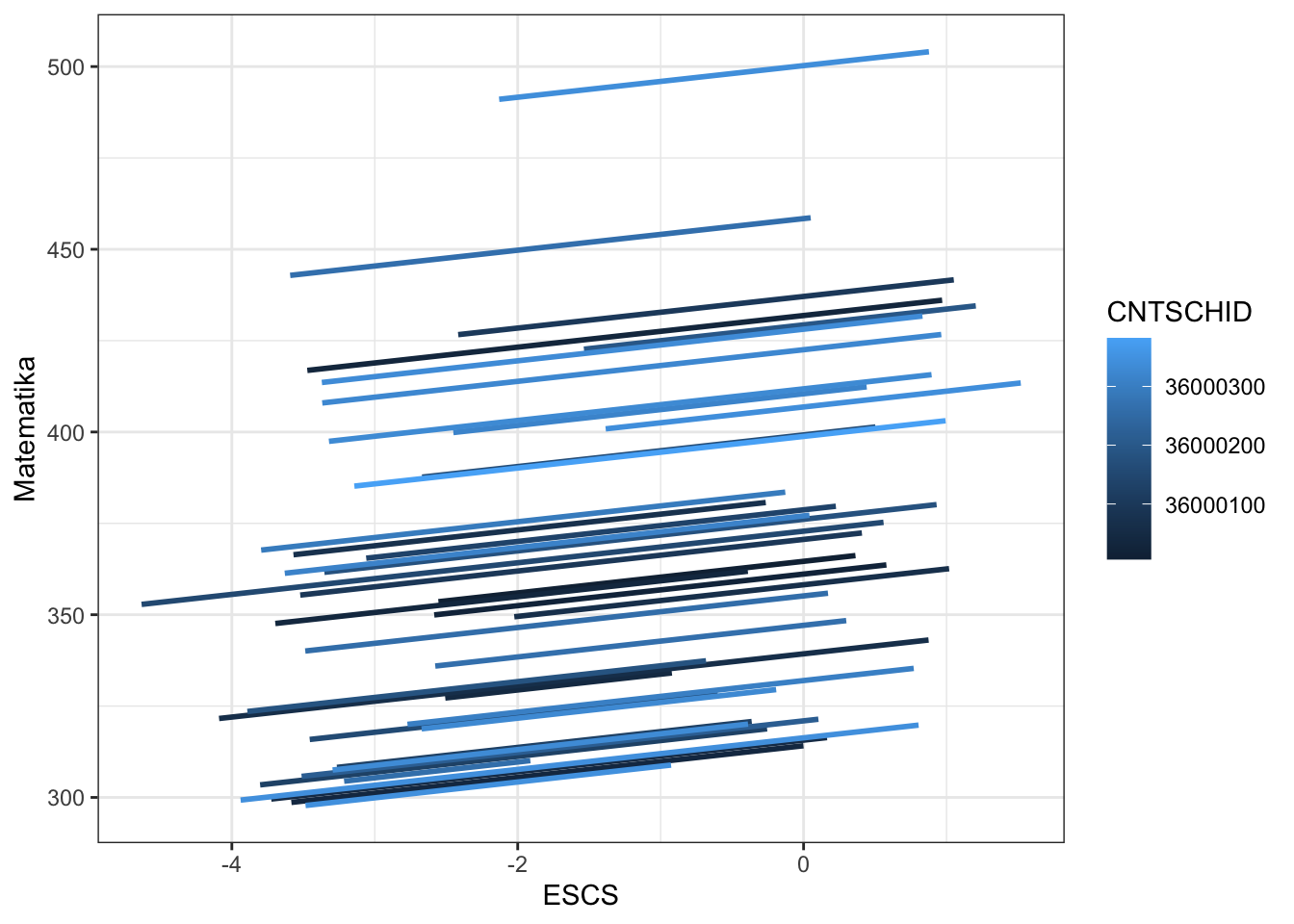
QQ-plot
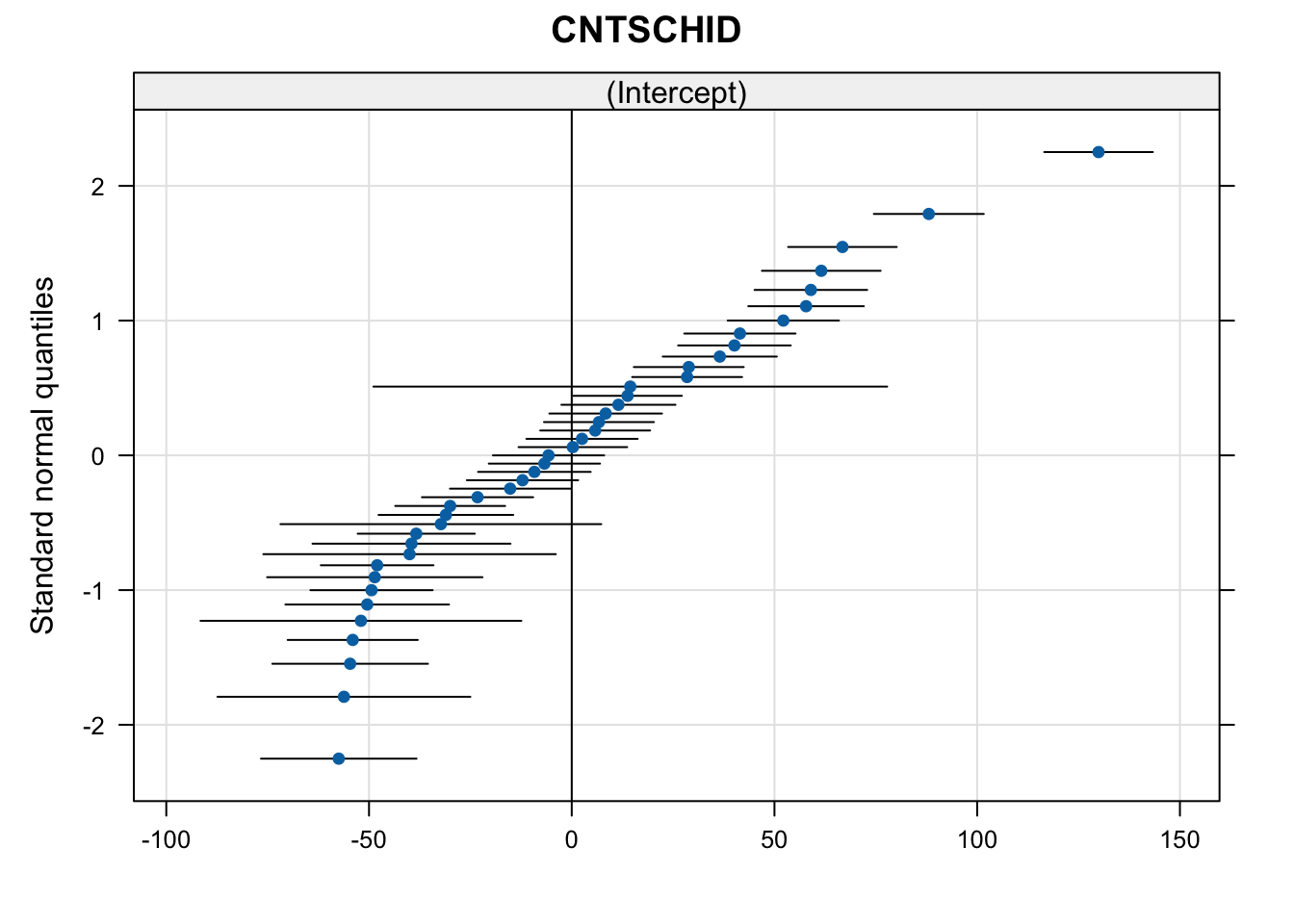
qqmath(ranef(m1, condVar = TRUE))$CNTSCHID